Showing posts with label LCLR. Show all posts

Sunday, 1 November 2020

Humberston - 009 Micro Diorama

Regular readers of this blog will be familiar with my Micro Dioramas, 70mm deep scenes designed to fit on the shelves of a wall-mounted display unit. There's a bit of a history here: A Brief History of Microramas

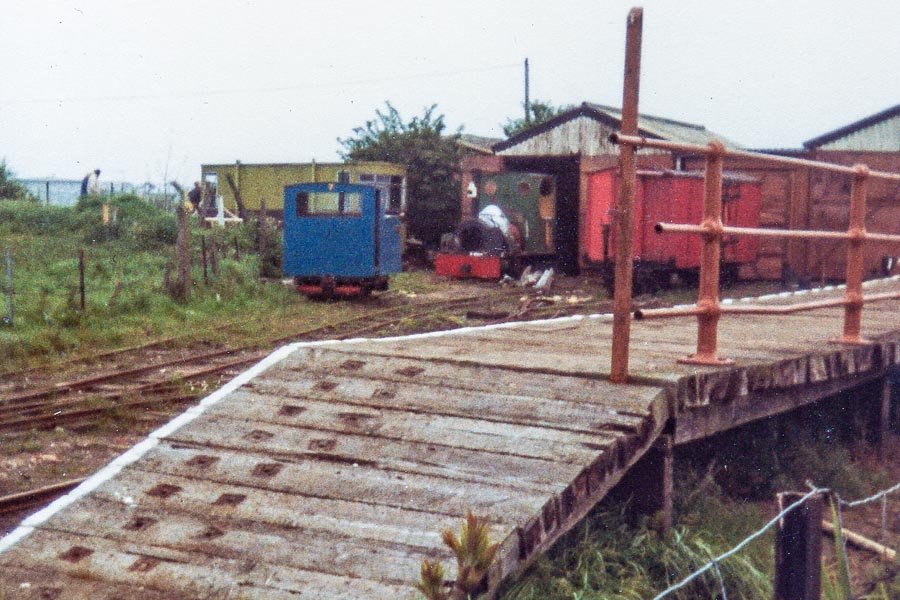
'Humberston' is a representation of the platform end of the original Lincolnshire Coast Light Railway terminus at North Sea Lane, Humberston as it might have appeared before the line closed there in 1985. The line had operated at Humberston from 1960, initially on a formation a short distance to the east, before moving lock, stock and barrel to a new formation to make way for an expanding camping and caravan park.


The line was slowly reborn at Winthorpe near Skegness during the 1990s and 2000s and has become a successful heritage operation, celebrating 60 years 2020, but sadly without any public operation.


Construction and conversion of the ex-Ashover coach from the Meridian Models kit has been described on this blog in The Humberston Amendments and Next Stop South Sea Lane, as has Wilton - 009 Simplex of Deception


This is not a fine-scale representation by any means, I have used commercial parts where possible to represent the prototype as closely as possible, including a Wills platform kit and model boat stanchions, as described in The Road to Humberston.


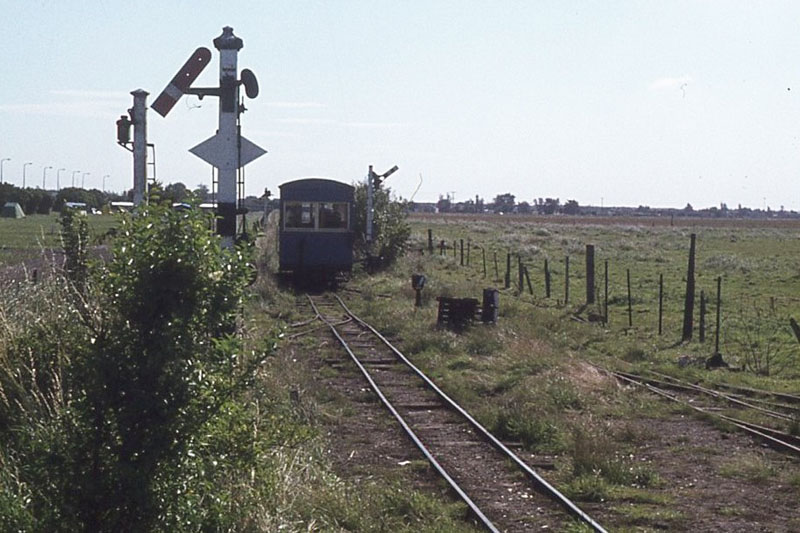
I had wavered slightly on the issue of the ex-GNR somersault signal but in the end felt that it was such a distinct feature of the prototype I had to include it. It also really balances the scene out visually.


I never saw the LCLR at Humberston. Last weekend I drove past the station site and you would never know that it was ever there, under the sprawl of the current caravan park. To find out more, I always commend a visit to the LCLR Pages on Dave Enefer's Website.

Colin

Friday, 30 October 2020

The Road to Humberston

Earlier in October I completed the paintwork on my 009 LCLR Simplex 'Wilton'. Citadel 'Lothern Blue for the main bodywork, which had 4 slightly-thinned coats; Vallejo red on the bufferbeams, and a slightly lightened black on the frames, all hand-painted. Humbrol matt acrylic aerosol varnish has done a reasonable job of hiding the brush marks.


Glazing was almost as tedious as I thought it might be, 20 thou sheet cut to size to fit the apertures and held in place with Johnson's Kleer. Just for an idea of scale, the cab front window is 4.5 x 15mm... Just visible in the cab is the driver, a Hornby figure with his raised right arm lowered to about the position of the handbrake wheel on a Simplex (don't tell anyone but I haven't modelled it!). Primed, given a black wash and then dry brushed with flesh colour and overall blue in appropriate places he is certainly minimalist. Once he was fixed in place the cab roof was secured in position.


I realise I have been a little remise and not mentioned anything about the LCLR diorama for the coach and 'Wilton'. Here is a glimpse at an early stage or development, the platform is a much modified Wills station halt kit, reduced in height and with alterations to the support structure.


The track was painted using Halfords matt brown sprayed at the rail sides, and Humbrol matt brown (a lighter shade) sprayed down on the sleepers. Ballast is Woodland Scenics fine grey mixed with ash and AK smoke grey pigment, secured in place using Johnson's Kleer. Ground cover is my usual PVA/polyfiller/brown paint mix with WS fine turf sprinkled on, and grass from hanging basket liner. This was manicured with nail scissors and hair clippers, the various effects added with hairspray and scatter and some Martin Welberg weed tufts to add extra colour and texture.

The platform was sprayed in grey primer and then painted using washes of dark grey and brown followed by dry-brushing to give differing wood shades. The white line was masked off and off-white dry brushed on, which looked far too straight so I added in a few points of disruption...


The wooden platform at the North Sea Lane terminus of the LCLR was backed with a stanchion/rail fence, no doubt recovered from elsewhere. It is seen to good effect in this picture on Dave Enefer's website: http://www.davesrailpics.bravehost.com/lclr/img337w.jpg 

As this would appear at the front of the diorama I had some reservations about building this as it might be a view blocker, but decided to rise to the challenge and obtained some 15mm 3-hole model boat stanchions from eBay. With the aid of a jig drilled in some scrap ply I soldered 0.7mm brass wire in as the cross bars. When setting the posts into the platform I drilled 0.9mm holes and then opened then out with a 1.9mm drill to sink the base down a little. The post at the end looks to have had a sign on it at some point but I'm not sure what it was.


The platform fence had a light coat of etch primer and was then painted in Humbrol red/brown, with some red and yellow mixed in in an attempt to lighten it a bit. A lighter shade was dry-brushed over this and Humbrol matt varnish sprayed over, maybe a little too heavily on purpose to get a bit of a ghosting effect. Once dry it was set in place, showing here how it isn't that much of a view block despite being at the front.


A distinctive feature of the LCLR North Sea Lane station was the ex-GNR somersault signal used as starter (although I get the feeling it was more ornamental!). Seen here in a rather overgrown state: http://www.davesrailpics.bravehost.com/lclr/img685w.jpg 

My attempt is scratchbuilt with the aid of a couple of etched parts supplied by my Dad. He also supplied the post, vintage Hornby Dublo, which (collectors look away now...) was cut down in height. Barring the ladder and wheel (both from old A1 etches) all other parts are scratchbuilt in styrene, with the bracket holding the arm being reinforced with wire to represent the operating rod.


The signal was painted, firstly with a waft of etch primer, followed once dry by a coat of white primer, and then some careful masking to apply the black and red with acrylics. Following a coat of matt varnish I applied some light weathering and posed it with the ladder in place. This is now ready to go in place on the diorama, update soon...

Colin


Sunday, 27 September 2020

'Wilton' - the 009 Simplex of deception

On return from holiday at the end of August  I decided to start a new project that has been in the planning for a while now. Having completed the ex-Ashover coach in LCLR condition and with a micro-diorama in mind, I needed a typical LCLR locomotive to stand with it. Having done some research into the various options I had settled on no.4 'Wilton' in it's Humberston condition. It still had the original bodywork when I visited the LCLR at Winthorpe in 2013 but has since been rebodied in a different style.


Having looked into various options on Shapeways for an 009 3D print Simplex chassis I eventually opted to scratchbuild the whole model, but incorporating the 3D printed buffer/couplings designed by David Malton that I had purchased some time ago. Building the model in this way allowed me to incorporate most of the bonnet into the chassis, giving the opportunity to add strength. Construction started in 30 thou styrene on the 30th August.


The cab was added from 30 thou styrene and 10 thou material overlaid on the bonnet sides to create the effect of the side sheeting overlapping the chassis frame. Surplus brass from A1 Models kit frets was used for the bonnet top and (presently removable) cab roof to gain strength in thin material. Details were built up using styrene rod for rivet heads, the exhaust and grease points on the axleboxes. The grille material on the front is from an ancient piece out of an MTK kit, inelegant but so is the prototype... The buffer/couplings were fixed in place and the plate around the bottom added from brass strip. 


Underneath the model there is a little bit of cheating going on. It is of course a dummy loco and rides on two Farish wheelsets. These are held in brass 'U' shapes drilled to hold the pin points, then attached to a length of styrene girder. Further bits of brass add strength either side. The axleboxes were fabricated from 20 thou styrene strip (20x80 and 20x20) and shaped once set to the distinctive Simplex shape.


Just as I thought the model would be ready for the paintshop, something was bugging me about it. I'd mostly worked from indistinct images, downloaded and printed on copier paper. I was not convinced that I had the boltheads on the frame in the right places (or enough of them) and looking at pictures of the loco as rebodied eventually confirmed this. Why I hadn't done this previously I've no idea... Going to add them I realised that the scrap of 20 thou styrene rod I had been using had been used up... This led to an order with 7mm Narrow Gauge Association Supplies being made on Sunday morning, arriving on Wednesday this week. 

I was then able to correct the bolt head detailing and then spray the model in primer.
 

I also realised that I had not added a cab door handle, and that perhaps the bonnet top needed a representation of hinges...


There are a few tidying jobs to do but I'm pretty happy with the result, hopefully it won't be long before the blue paint is required...

Colin

Thursday, 6 August 2020

Next Stop, South Sea Lane

After nearly a month in the paint shop the Lincolnshire Coast Light Railway ex-Ashover coach is now painted to my satisfaction. Apart from primer and varnish this has been completely brush painted. The ivory is Vallejo 'Ivory' and the blue Citadel 'Lothern Blue'. The grey and black shades on the roof and underframe are mixed from various blacks/greys etc. Like a fool I forgot to paint any of the interior until after completing the exterior (!) and opted to use a simple scheme of blue/ivory in the vestibules and just grey primer and brown seats inside the saloon - you cannot really tell through the windows.


After a coat of Humbrol aerosol matt varnish the windows have been glazed individually using 20 thou material (sides) and 10 thou (ends), fixed in place with Johnsons Kleer. The roof was then fixed in place with solvent-free Uhu, but not before a couple of low-key plastic figures were added inside at one end. 


I then applied some weathering, a subtle dry-brush around the underframe trusses and bogies, and some slightly less subtle effects on the roof, which had a wash of a translucent brown paint and then dry-brushing in grey/brown. Part of me feels I might have gone a bit too far with the streaks, but I remind myself that it is from a seaside railway and will have encountered it's fair share of Seagull "deposits" that would have been washed down in the rain...


Whilst I mull over the options for a diorama or operational use it has gone into the display case to be admired. In the meantime another coach has appeared in the paint shop to appear in a similar livery, and that is O9...

Colin


Friday, 3 July 2020

The Humberston Amendments

After much deliberation as to how good a job I could make of it, I removed the drop-frames in the windows from the ex-Ashover coach. Using a 0.5mm drill bit a hole was drilled in each corner of the frame and with a new blade in the craft knife I carefully cut around the edge of the frame. This removed the frames quite cleanly and any tidying up was achieved with an emery board and one of my home made sanding sticks.


Some reconstruction work was required to create the LCLR style frames. It's nowhere near the amount of reconstruction the real thing has received! The more I look at photos the more I can see how the non-platform side of the coach currently in use at Winthorpe is in effect totally new, replacing the side removed when the coach was used as a stand at a sports ground. As such the model will never fully replicate the prototype, but I can live with that.


Having removed the moulded drop-frames I replaced them with a representation of the LCLR window frames. I've made an allowance to semi flush-glaze by leaving a 20 thou recess at the back of the new arrangement, to achieve this another brass template was created to assist. The new pieces started with the sill cut from 10 x 30 thou Evergreen strip, then the inner beading from fine strips cut from 5 thou Evergreen sheet. A further strip of 5 thou material has been added across the top of the side to represent a strip that on the prototype is attached to the roof. This is supported over the doorways by a strip of 30 x 60 thou styrene reduced down on one edge.


The end windows had a new insert along the bottom edge from 10 x 20 thou strip. I've also added lamp brackets at both ends in the LCLR position, and representations of the bolt heads on the corner post from 0.5mm styrene rod. On the side with doorways further slices of rod represent the fixings at the end of the handrails (removed at the moment to be reinstated after painting). I've also added a representation of detail to the base of the brake handle using an EDM Models bolt head/washer and a slice of larger plastic rod.


I have opted not to alter the tiebars and to accept this as a compromise, I've also decided not to add air brake pipes etc, these were only added in the 1980s and I can only find evidence of this vehicle having an air brake pipe at one end whilst at Humberston, but both ends at Winthorpe. As these details are a bit ambiguous I have left them off, but they could be added at a later date if required.

Colin

Sunday, 14 June 2020

From Ashover with Love

Back in February I was given a Meridian Models Ashover coach for my birthday. Having ridden in the real thing a few times at the Lincolnshire Coast Light Railway this is an item of interest for me. I had considered doing a build in true LCLR condition, but the more you look at the coaches at Winthorpe, the more the 60 years or more of use and (putting it politely) rebuild work, shows up. Early pictures of them at Humberston reveal that not a great deal could have been left in the 1960s when they were acquired, these are two of the vehicles used as spectator stands so probably lost a lot of material whilst at Clay Cross.

Looking at one of my 2013 pictures, the obvious changes are that the drop-windows are gone on sides and ends, the sliding doors are replaced by hinged doors on one side (fixed panels on the other), the steps are gone and even the underframe trussing is different - it was newly fitted at Humberston.


I have therefore resigned myself to a build of the kit that captures the essence of the LCLR but maybe not the details. I feared that taking great chunks out of the window frames would not end well (or neatly) and the doors seem essential to maintaining squareness. I know others have made very interesting conversions from these kits, but as a first-timer this is essentially a straight-build of the kit.


Further study of photos revealed that the LCLR coaches have no torpedo vents on the roof - of course I checked this after fitting them so off they came and the holes were filled in... The roof of the LCLR examples also looks somehow "heavier" so have used 20 thou material rather than the 15 thou material supplied.

I'm now considering a couple of changes to the build that ought to add some individuality. Having looked at the photos and drawings the handrails by the doors are rather prominent and I am considering adding these in 0.3mm wire. I'm also considering opening up the door windows as a halfway house between ALR and LCLR condition. We shall see...
 

Colin


Friday, 10 April 2020

Humberston on my Mind

It's funny how both the backscene images used on the rebuild of 'Beck Bridge' were from the Humberston area. Just south of Cleethorpes this village has an interesting place in the history of narrow gauge railways, with lines in the past serving quarrying, a brickworks and of course the Lincolnshire Coast Light Railway, the pioneering green field narrow gauge preservation line that served a real transport function between the bottom of North Sea Lane and the Fitties holiday camps.

I never saw the railway at Humberston, first seeing the stock in storage at Burgh le Marsh as a child, but I later properly made it's acquaintance at Winthorpe near Skegness in 2013. Towards the end of February it seemed that there might be something happening model wise, with the arrival of a Bachmann ex-WD van in LCLR red and a Meridian Models Ashover coach kit. 


Now these won't fit on my 009 layout 'The Old Quarry Line', I can only just get the shorter WD open wagon around the corners! Several ideas are bouncing around for dioramas, I even made up a cardboard mock-up of the popular "cake box" (8" x 8" x 5") size to see what was feasible. Ironically I realised that I could have rebuilt 'Beck Bridge' from it's original cat food box form to this size quite easily had I though of it at the time...


One thing I have learnt from recent experience is that if I am going to build dioramas, they need to be capable of being displayed somewhere, preferably protected from dust. Could I get the atmosphere of the LCLR in one of my 7cm deep display case scenes? Well quite possibly - the yellow line is the outline, the Ruston should be a Simplex and please excuse the cardboard coach mock up! A simpler version without the van is also a possibility.


You might wonder why use the Meridian kit coach rather than the forthcoming Bachmann model. Well, firstly, it is forthcoming with no release date announced. Secondly, and more importantly, study of the LCLR coaches reveals they are very different from Ashover condition, and I suspect that Bachmann may not address these issues. The original sliding doors are gone, as are the droplights and original window frames, and there are differences in the panelling. Also the two LCLR vehicles differ from each other. Using the kit, altering the doorways and some subtle changes will make create a model much closer to the vehicle I have travelled on.


Of course if I pursue this path I'll have to built one of the LCLRs distinctive rebuilt Simplex locomotives as a static loco too, there are several to choose from, the best source material is on Dave Enefer's davesrailpics site (be prepared to lose a few hours in there...)

Colin